
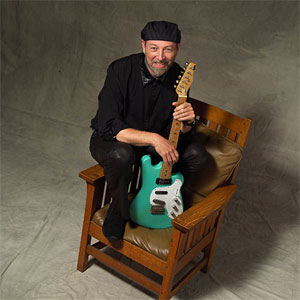
He’s a living legend, he’s in his sixth deca
de of music-making…and he’s answering 17 Seconds’ questions! Richard Thompson reflects on living in America, Fairport Convention and Nick Drake, and songwriting
17 Seconds: Hi Richard! How are you, where are you, and what’s the weather like?
Richard Thompson (RT): I am fine, I’m in New Jersey.
The weather is changeable, to say the least.
17 Seconds: You’ve just released 13 R
ivers, your new album. It’s the first one you’ve self-produced in a while, and the record burns with an intensity, lyrically and musically [i mean this as a compliment]. What can you tell us about the creative process of writing and recording the album?
RT: I wrote the songs in the space of about 4 months. I find it hard to describe the actual creative process, as it seems to be a semi-conscious thing. We recorded it analogue at Liberace’s old studio in Hollywood, in about 10 days.
17 Seconds: You’re now based in the States. What prompted your move there, did it change how you made music and what do you miss about the U.K.?
RT: I’ve been based in the States for about 30 years. Basically I work here more than anywhere else, so it makes sense in terms of travel. Culturally I find it fairly neutral.
17 Seconds: In 1991, you released ‘Vincent Black Lightning 1952,’ on the album Rumor And Sigh. Is it true you researched the song and how long did it take to write?
RT: When I was a kid, a neighbour had a Vincent Bla
ck Shadow, just a gorgeous bike, and I think that stayed with me. Before writing the song, I wanted to know everything about it, so I studied the history, got the workshop manual – then I could write with a bit of authenticity, and of course leave most of the stuff out. It took a couple of days to write, after a few false starts.
17 Seconds: You played on Nick Drake’s Five Leaves Left. What are your memories of the sessions and the man himself?
RT: I knew Nick because we had the same management and record label, so I’d see him around and about, but he didn’t say much – neither did I at the time
. I always overdubbed on his records, when he wasn’t in the studio.
17 Seconds: 1969 must have been a busy and intense year for you and Fairport Convention. What are your recollections of the year?
RT: The album What We Did On Our Holidays came out in January, but we had finished it a few
with fast delivery modalert for sale with the lowest prices today in the USA
months earlier. We released Unhalfbricking in May, after a traumatic van crash that liked our drummer [Martin Lamble, who was only nineteen]. We spent the Summer working on changing our repertoire to embrace more British traditional music. We played our new songs at the Festival Hall in September, and released L
iege And Lief in November. It was busy…
17 Seconds: What, if anything, does the term ‘folk music’ mean in 2018?
RT: To some, folk means traditional, to others, it just means acoustic
– so I avoid using the word. I’m glad that more rootsy music is closer to the mainstream these days. It used to be tucked away in a very separate world, Now people are more aware of Eliza Carthy or Kate Rusby, for instance.
17 Seconds: Who, if anyone, do you consider your musical contemporaries?
RT: The survivors of Fairport, Steeleye, the Albion Band…and singer-songwriters like Loudon Wainwright and John Prine.
17 Seconds: You celebrate a, um, significant birthday next year. How will you mark it?
RT: I shall hide in a
cave.
17 Seconds: Finally, what music are you listening to at the moment?
RT: Wildwood Kin, Offa Rex, The Rails, Lots of dead people.
13 Rivers is out now on Proper. Richard Thompson’s UK tour starts on October 11 (see here for details).